4. Bathymetry and Boundary Conditions
4.1. Non-zero Source Term
Adding bathymetry to the f-wave solver is easy because you can subtract it from the multiplication of the inverse and the jump in fluxes:
The term \(\Delta x \Psi_{i-1/2}\) summarizes the effect of the bathymetry:
Now, let’s implement the bathymetry in our F-wave solver:
Let’s modify the
eigencoefficientAlphafunction:
void tsunami_lab::solvers::fwave::eigencoefficientAlpha(t_real i_inverse[4],
                                                     t_real i_delta_f[2],
                                                     t_real i_b,
                                                     t_real o_eigencoefficients[2]){
   //  ∆f - bathymetry
 i_delta_f[1] = i_delta_f[1] - i_b;
 //m x n ° n x p =
 o_eigencoefficients[0] = (i_inverse[0] * i_delta_f[0]) + (i_inverse[1] * i_delta_f[1]);
 o_eigencoefficients[1] = (i_inverse[2] * i_delta_f[0]) + (i_inverse[3] * i_delta_f[1]);

}
Now, let’s modify our
netupdatesfunction:
void tsunami_lab::solvers::fwave::netUpdates(t_real   i_hL,
                                           t_real   i_hR,
                                           t_real   i_huL,
                                           t_real   i_huR,
                                           t_real   i_bL,
                                           t_real   i_bR,
                                           t_real   o_minus_A_deltaQ[2],
                                           t_real   o_plus_A_deltaQ[2]){
  bool l_updateR = true;
  bool l_updateL = true;

  //two dry cells next to each other you cant divide by zero
  if(i_hL == 0 && i_hR == 0 ){
      o_minus_A_deltaQ[1] = 0;
      o_minus_A_deltaQ[0] = 0;
      o_plus_A_deltaQ[1] = 0;
      o_plus_A_deltaQ[0] = 0;

      return;

  }
  //left cell is a dry cell
  else if(i_hL == 0){

      i_hL = i_hR;
      i_huL = -i_huR;
      i_bL = i_bR;
      l_updateL = false;

  }
  //right cell is a dry cell
  else if(i_hR == 0){

      i_hR = i_hL;
      i_huR = -i_huL;
      i_bR = i_bL;
      l_updateR = false;
  }


  t_real l_uL = i_huL / i_hL;
  t_real l_uR = i_huR / i_hR;

  t_real l_sL = 0;
  t_real l_sR = 0;

  eigenvalues(i_hL,i_hR,l_uL,l_uR,l_sL,l_sR);

  t_real l_inverse[4];

  inverseMatrix(l_sL, l_sR, l_inverse);

  t_real l_fdelta[2];
  flux(i_hL,i_hR,i_huL,i_huR,l_fdelta);

  t_real l_b = (-m_g) * (i_bR-i_bL) *((i_hL+i_hR)/2);

  t_real l_eigencoefficients[2];
  eigencoefficientAlpha(l_inverse,l_fdelta,l_b,l_eigencoefficients);


  t_real l_eigens[2] = {l_sL,l_sR};
  decompose(l_eigencoefficients,l_eigens,o_minus_A_deltaQ,o_plus_A_deltaQ);


  //if left cell is dry its A-∆Q is zero
  if(!l_updateL){
      o_minus_A_deltaQ[1] = 0;
      o_minus_A_deltaQ[0] = 0;
  //if left cell is dry its A+∆Q is zero
  }if(!l_updateR){
      o_plus_A_deltaQ[1] = 0;
      o_plus_A_deltaQ[0] = 0;
    }
 }
Let’s add the bathymetry to the
WavePropagation.hfile:
virtual void setBathymetry(t_idx  i_ix,
                         t_idx  i_iy,
                         t_real i_b)=0;

virtual t_real const * getBathymetry() = 0;
At last, let us add it to the
WavePropagation1d.cppfile:3.1. You have to allocate the memory for the bathymetry cells and init it to zero :
tsunami_lab::patches::WavePropagation1d::WavePropagation1d( t_idx i_nCells,bool i_choice ) {
    m_choice = i_choice;
    m_nCells = i_nCells;

 // allocate memory including a single ghost cell on each side
    for( unsigned short l_st = 0; l_st < 2; l_st++ ) {
    m_h[l_st] = new t_real[  m_nCells + 2 ];
    m_hu[l_st] = new t_real[ m_nCells + 2 ];
    }
    m_b = new t_real[ m_nCells + 2 ];

 // init to zero
    for( unsigned short l_st = 0; l_st < 2; l_st++ ) {
    for( t_idx l_ce = 0; l_ce < m_nCells; l_ce++ ) {
    m_h[l_st][l_ce] = 0;
    m_hu[l_st][l_ce] = 0;
    m_b[l_ce] = 0;
       }
    }
 }
3.2. Now, let’s include it in the timeStep function:
void tsunami_lab::patches::WavePropagation1d::timeStep( t_real i_scaling) {
   // pointers to old and new data
   t_real * l_hOld  = m_h[m_step];
   t_real * l_huOld = m_hu[m_step];


   t_real * l_b  = m_b;

   m_step = (m_step+1) % 2;
   t_real * l_hNew =  m_h[m_step];
   t_real * l_huNew = m_hu[m_step];


   // init new cell quantities
   for( t_idx l_ce = 1; l_ce < m_nCells+1; l_ce++ ) {
      l_hNew[l_ce]  = l_hOld[l_ce];
      l_huNew[l_ce] = l_huOld[l_ce];
   }

   // iterate over edges and update with Riemann solutions
   for( t_idx l_ed = 0; l_ed < m_nCells+1; l_ed++ ) {
      // determine left and right cell-id
      t_idx l_ceL = l_ed;
      t_idx l_ceR = l_ed+1;

      // compute net-updates
      t_real l_netUpdates[2][2];
      //std:: cout << l_bOld[l_ceR] << std::endl ;

      if(m_choice){
         solvers::Roe::netUpdates(l_hOld[l_ceL],
                                 l_hOld[l_ceR],
                                 l_huOld[l_ceL],
                                 l_huOld[l_ceR],
                                 l_netUpdates[0],
                                 l_netUpdates[1]);
      }else{
         solvers::fwave::netUpdates( l_hOld[l_ceL],
                                    l_hOld[l_ceR],
                                    l_huOld[l_ceL],
                                    l_huOld[l_ceR],
                                    l_b[l_ceR],
                                    l_b[l_ceL],
                                    l_netUpdates[0],
                                    l_netUpdates[1]);
      }

      // update the cells' quantities
      l_hNew[l_ceL]  -= i_scaling * l_netUpdates[0][0];
      l_huNew[l_ceL] -= i_scaling * l_netUpdates[0][1] ;


      l_hNew[l_ceR]  -= i_scaling * l_netUpdates[1][0];
      l_huNew[l_ceR] -= i_scaling * l_netUpdates[1][1] ;


   }
}
3.3. Now, let’s set the boundary of the bathymetry in the
setGhostOutflowfunction:void tsunami_lab::patches::WavePropagation1d::setGhostOutflow() { t_real * l_h = m_h[m_step]; t_real * l_hu = m_hu[m_step]; t_real * l_b = m_b; // set left boundary l_h[0] = l_h[1]; l_hu[0] = l_hu[1]; l_b[0] = l_b[1]; // set right boundary l_h[m_nCells+1] = l_h[m_nCells]; l_hu[m_nCells+1] = l_hu[m_nCells]; l_b[m_nCells+1] = l_b[m_nCells]; }3.3.4. lastly we have to add the bathymetry to the
~WavePropagation1dfunction:tsunami_lab::patches::WavePropagation1d::~WavePropagation1d() { for( unsigned short l_st = 0; l_st < 2; l_st++ ) { delete[] m_h[l_st]; delete[] m_hu[l_st]; } delete[] m_b; }
4.1.1. Effect of bathymetry in our F-Wave Solver
Now, let’s see the effect of bathymetry in our F-Wave solver. We are going to conduct a simulation using the Roe solver and our F-Wave solver for a specific setup to observe the impact of the bathymetry.
The setup we are going to use for the comparison:
l_setup = new tsunami_lab::setups::DamBreak1d(90,60,5);
But before we simulate, we add a function that computes the bathymetry. So, we go to the DamBreak1d.cpp and add bathymetry there.
tsunami_lab::t_real tsunami_lab::setups::DamBreak1d::getBathymetry( t_real i_x,
                                                                 t_real ) const {

return (-1.8-0.05*(i_x-10) *(i_x-10));

}
Now, let’s examine the results for 500 cells:
The height and momentum of the F-Wave solver are represented in dark blue and green, while those of the Roe solver are in red and light blue. In the video, we will notice that the bathymetry affected the wave speed and height. This is because the bathymetric features can influence the speed through wave refraction. Shallow areas may cause waves to shoal (decrease in depth), which leads to changes in wave height and wavelength.
4.2. Reflecting Boundary Conditions
Now, let’s implement the reflecting boundary condition as defined in the following equation:
\[\begin{split}h_{i} &:= h_{i-1} \\ (hu)_{i} &:= -(hu)_{i-1} \\ b_{i} &:= b_{i-1}\end{split}\]
The first thing is to change our
setGhostOutflowfunction in theWavePropagation1d.cppfile:
 void tsunami_lab::patches::WavePropagation1d::setGhostOutflow(bool i_choiceBoundry) {
m_choiceBoundry = i_choiceBoundry;
t_real * l_h = m_h[m_step];
t_real * l_hu = m_hu[m_step];
t_real * l_b = m_b;

// set left boundary
l_h[0] = l_h[1];
l_hu[0] = l_hu[1];
l_b[0] = l_b[1];

  // set right boundary
l_h[m_nCells+1] = l_h[m_nCells ];
l_b[m_nCells+1] = l_b[m_nCells ];


if(i_choiceBoundry == true){
  //reflecting boundary :same values except that the reflecting cell receives the paricel velocity with opposite sign
  l_hu[m_nCells+ 1] = -(l_hu[m_nCells ]);
}
else
{
  l_hu[m_nCells+1] = l_hu[m_nCells];
 }
 }
We added a boolean variable so that the reflecting boundary is not always active
Important
We also have to modify setGhostOutflow and also add all occurrences with the boolean input parameter.
Now we have to change our wave solver that it matches the boundary by modifying the
net-updatesfunction:
void tsunami_lab::solvers::fwave::netUpdates(t_real   i_hL,
                                          t_real   i_hR,
                                          t_real   i_huL,
                                          t_real   i_huR,
                                          t_real   i_bL,
                                          t_real   i_bR,
                                          t_real   o_minus_A_deltaQ[2],
                                          t_real   o_plus_A_deltaQ[2]){
 bool l_updateR = true;
 bool l_updateL = true;

 //two dry cells next to each other you cant divide by zero
 if(i_hL == 0 && i_hR == 0 ){
     o_minus_A_deltaQ[1] = 0;
     o_minus_A_deltaQ[0] = 0;
     o_plus_A_deltaQ[1] = 0;
     o_plus_A_deltaQ[0] = 0;

     return;

 }
 //left cell is a dry cell
 else if(i_hL == 0){

     i_hL = i_hR;
     i_huL = -i_huR;
     i_bL = i_bR;
     l_updateL = false;

 }
 //right cell is a dry cell
 else if(i_hR == 0){

     i_hR = i_hL;
     i_huR = -i_huL;
     i_bR = i_bL;
     l_updateR = false;
 }


 t_real l_uL = i_huL / i_hL;
 t_real l_uR = i_huR / i_hR;

 t_real l_sL = 0;
 t_real l_sR = 0;

 eigenvalues(i_hL,i_hR,l_uL,l_uR,l_sL,l_sR);

 t_real l_inverse[4];

 inverseMatrix(l_sL, l_sR, l_inverse);

 t_real l_fdelta[2];
 flux(i_hL,i_hR,i_huL,i_huR,l_fdelta);

 t_real l_b = (-m_g) * (i_bR-i_bL) *((i_hL+i_hR)/2);

 t_real l_eigencoefficients[2];
 eigencoefficientAlpha(l_inverse,l_fdelta,l_b,l_eigencoefficients);


 t_real l_eigens[2] = {l_sL,l_sR};
 decompose(l_eigencoefficients,l_eigens,o_minus_A_deltaQ,o_plus_A_deltaQ);


 //if left cell is dry its A-∆Q is zero
 if(!l_updateL){
     o_minus_A_deltaQ[1] = 0;
     o_minus_A_deltaQ[0] = 0;
 //if left cell is dry its A+∆Q is zero
 }if(!l_updateR){
     o_plus_A_deltaQ[1] = 0;
     o_plus_A_deltaQ[0] = 0;
   }


}
4.2.1. one-sided solution of the shock-shock setup
1. to solve this task we have to change the shock shock setup to match the task where reflecting boundary conditions at the right boundary, and outflow boundary conditions at the left boundary.
tsunami_lab::t_real tsunami_lab::setups::ShockShock::getMomentumX(t_real i_x,
                                                               t_real)const{

   return m_hu;

}
Now, we need to implement a shock setup in the main, and we have to set the
setGhostOutflowfunction to true in the main:
l_setup = new tsunami_lab::setups::ShockShock(6,
                                             6,
                                             5);

l_waveProp->setGhostOutflow(true);
....
Lastly, let’s simulate the shock setup:
4.3. Hydraulic Jumps
4.3.1. Maximum Froude value and location
The Froude number can be calculated through this formula:
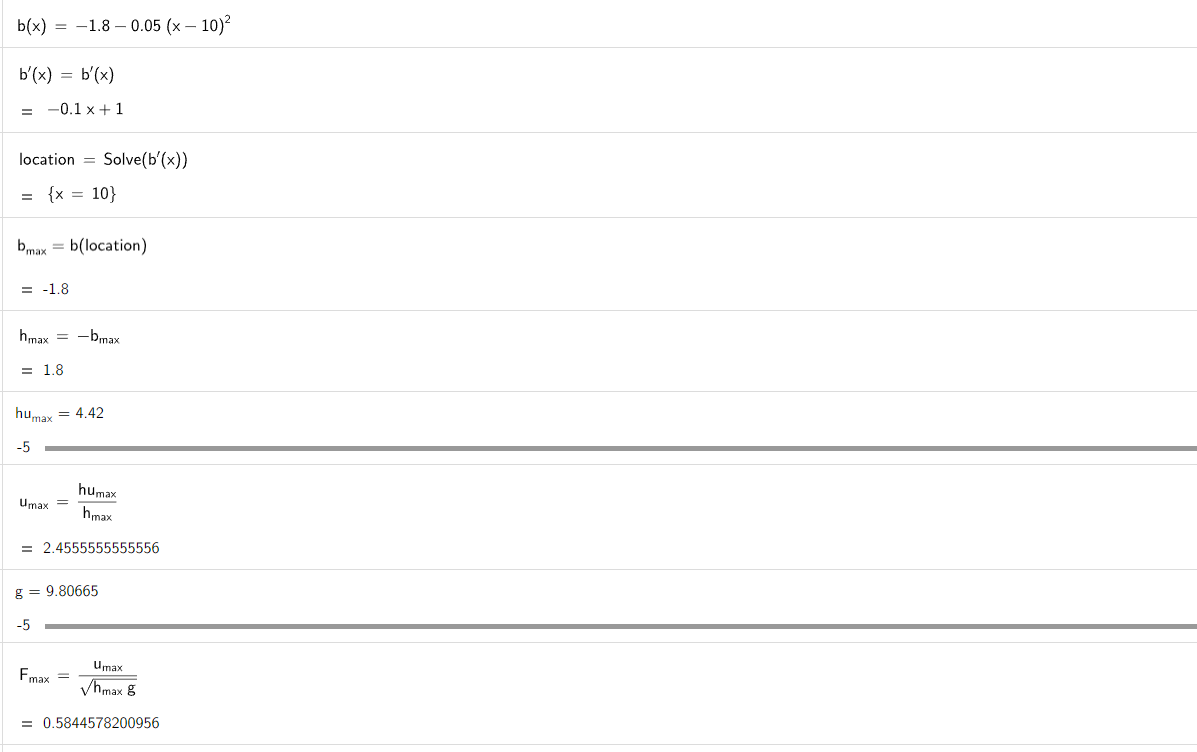
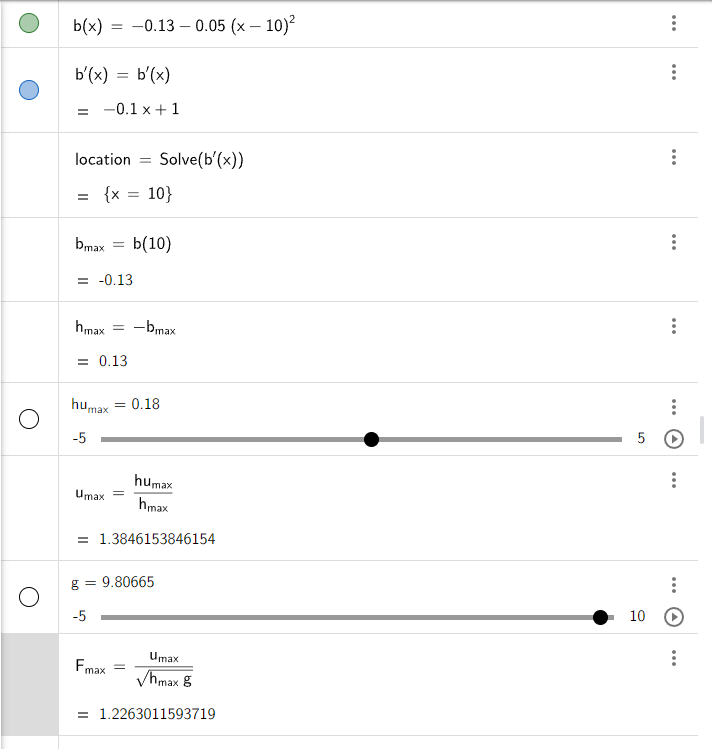
To calculate the maximum Froude value and the location of subcritical flow and supercritical flow, we need to determine the maximum of the following function:
and:
The calculations for the location and the value of the maximum Froude number for the subcritical setting can be observed in the following picture:
And for the supercritical setting, the calculations can be observed here:
4.3.2. setup
subcritical setting:
1.1 Now, let’s compute the subcritical setting as a setup. We will have to create three files:
SubcriticalFlow.cpp,SubcriticalFlow.h,SubcriticalFlow.test.cpp1.1.1. Let’s start with the
SubcriticalFlow.hfile :/** * @author Ward Tammaa * * @section DESCRIPTION * subcriticalFlow. **/ #ifndef TSUNAMI_LAB_SETUPS_SUBCRITICAL_FLOW_H #define TSUNAMI_LAB_SETUPS_SUBCRITICAL_FLOW_H #include "../Setup.h" namespace tsunami_lab { namespace setups { class SubcriticalFlow; } } class tsunami_lab::setups::SubcriticalFlow: public Setup { public: /** * Gets the water height at a given point. * * @param i_x x-coordinate of the queried point. * @return height at the given point. **/ t_real getHeight( t_real i_x, t_real ) const; /** * Gets the momentum in x-direction. * * @return momentum in x-direction. **/ t_real getMomentumX( t_real , t_real ) const; /** * Gets the momentum in y-direction. * @return momentum in y-direction. **/ t_real getMomentumY( t_real, t_real ) const; t_real getBathymetry( t_real i_x, t_real ) const ; }; #endif
- 1.1.2. Now, let’s implement the
SubcriticalFlow.cppusing the following settings : For the subcritical flow we use the following initial values:
\[\begin{split}\begin{aligned} b(x) &= \begin{cases} -1.8 - 0.05 (x-10)^2 \quad &\text{if } x \in (8,12) \\ -2 \quad &\text{else} \end{cases}\\ h(x, 0) &= -b(x) \quad \text{if } x \in [0,25] \\ hu(x, 0) &= 4.42 \quad \text{if } x \in [0,25]. \end{aligned}\end{split}\]the equivalent code for the settings :
/**
 * @author Ward Tammaa (alex.breuer AT uni-jena.de)
 *
 * @section DESCRIPTION
 * SubcriticalFlow.
 **/
#include "SubcriticalFlow.h"
#include <cmath>

tsunami_lab::t_real tsunami_lab::setups::SubcriticalFlow::getHeight( t_real i_x,
                                                 t_real      ) const {
  return -getBathymetry(i_x,0);
}

tsunami_lab::t_real tsunami_lab::setups::SubcriticalFlow::getMomentumX( t_real,
                                                    t_real ) const {
  return 4.42;
}

tsunami_lab::t_real tsunami_lab::setups::SubcriticalFlow::getMomentumY( t_real,
                                                    t_real ) const {
  return 0;
}

tsunami_lab::t_real tsunami_lab::setups::SubcriticalFlow::getBathymetry( t_real i_x,
                                                     t_real ) const {
  if(i_x > 8 && i_x < 12){
    return (-1.8-0.05*pow((i_x-10), 2));
  }else{
    return -2;
  }

}
1.1.3. lastly let’s implement a unit test for subcriticalFlow in the
SubcriticalFlow.test.cppfile:/** * @author Ward Tammaa * * @section DESCRIPTION * Tests SubcriticalFlow. **/ #include <catch2/catch.hpp> #include "SubcriticalFlow.h" TEST_CASE( "Test the Subcritical flow setup.", "[SubcriticalFlow]" ) { tsunami_lab::setups::SubcriticalFlow l_subcriticalFlow; // left side REQUIRE( l_subcriticalFlow.getHeight( 2, 0 ) == 2 ); REQUIRE( l_subcriticalFlow.getMomentumX( 2, 0 ) == 4.42f); REQUIRE( l_subcriticalFlow.getMomentumY( 2, 0 ) == 0 ); REQUIRE( l_subcriticalFlow.getBathymetry( 2, 0 ) == -2 ); REQUIRE( l_subcriticalFlow.getHeight( 2, 5 ) == 2 ); REQUIRE( l_subcriticalFlow.getMomentumX( 2, 5 ) == 4.42f); REQUIRE( l_subcriticalFlow.getMomentumY( 2, 2 ) == 0 ); REQUIRE( l_subcriticalFlow.getBathymetry( 10, 0 ) == -1.8f ); // right side REQUIRE( l_subcriticalFlow.getHeight( 10, 0 ) == 1.8f); REQUIRE( l_subcriticalFlow.getMomentumX( 4, 0 ) == 4.42f); REQUIRE( l_subcriticalFlow.getMomentumY( 4, 0 ) == 0 ); REQUIRE( l_subcriticalFlow.getBathymetry( 2, 0 ) == -2.0f ); REQUIRE( l_subcriticalFlow.getHeight( 4, 5 ) == 2 ); REQUIRE( l_subcriticalFlow.getMomentumX( 4, 5 ) == 4.42f); REQUIRE( l_subcriticalFlow.getMomentumY( 4, 2 ) == 0 ); REQUIRE( l_subcriticalFlow.getBathymetry( 10, 0 ) == -1.8f ); }
- 1.1.2. Now, let’s implement the
supercritical setting:
2.1 Now, let’s compute the Supercritical Flow setting as a setup. We will have to create three files: SupercriticalFlow.cpp , SupercriticalFlow.h , SupercriticalFlow.test.cpp
2.1.1. Let’s start with the
SupercriticalFlow.hfile :/** * @author Ward Tammaa * * @section DESCRIPTION * supercriticalflow. **/ #ifndef TSUNAMI_LAB_SETUPS_SUPERCRITICAL_FLOW_H #define TSUNAMI_LAB_SETUPS_SUPERCRITICAL_FLOW_H #include "../Setup.h" namespace tsunami_lab { namespace setups { class SupercriticalFlow; } } class tsunami_lab::setups::SupercriticalFlow: public Setup { public: /** * Gets the water height at a given point. * * @param i_x x-coordinate of the queried point. * @return height at the given point. **/ t_real getHeight( t_real i_x, t_real ) const; /** * Gets the momentum in x-direction. * * @return momentum in x-direction. **/ t_real getMomentumX( t_real , t_real ) const; /** * Gets the momentum in y-direction. * @return momentum in y-direction. **/ t_real getMomentumY( t_real, t_real ) const; t_real getBathymetry( t_real i_x, t_real ) const ; }; #endif
- 2.1.2. Now, let’s implement the
SupercriticalFlow.cppusing the following settings :For the Supercritical flow we use the following initial values:
\[\begin{split}\begin{aligned} b(x) &= \begin{cases} -0.13 - 0.05 (x-10)^2 \quad &\text{if } x \in (8,12) \\ -0.33 \quad &\text{else} \end{cases}\\ h(x, 0) &= -b(x) \quad \text{if } x \in [0,25] \\ hu(x, 0) &= 0.18 \quad \text{if } x \in [0,25]. \end{aligned}\end{split}\]the equivalent code for the settings :
/**
 * @author Ward Tammaa
 *
 * @section DESCRIPTION
 * SupercriticalFlow.
 **/
#include "SupercriticalFlow.h"
#include <cmath>

tsunami_lab::t_real tsunami_lab::setups::SupercriticalFlow::getHeight( t_real i_x,
                                                 t_real      ) const {
  return -getBathymetry(i_x,0);
}

tsunami_lab::t_real tsunami_lab::setups::SupercriticalFlow::getMomentumX( t_real,
                                                    t_real ) const {
  return 0.18;
}

tsunami_lab::t_real tsunami_lab::setups::SupercriticalFlow::getMomentumY( t_real,
                                                    t_real ) const {
  return 0;
}

tsunami_lab::t_real tsunami_lab::setups::SupercriticalFlow::getBathymetry( t_real i_x,
                                                     t_real ) const {
if(i_x > 8 && i_x < 12){
  return -0.13-0.05*((i_x-10)*(i_x-10));
}else{
   return -0.33;
}
2.1.3. lastly let’s implement a unit test for SupercriticalFlow in the
SupercriticalFlow.test.cppfile:/** * @author Ward Tammaa * * @section DESCRIPTION * Tests SubcriticalFlow. **/ #include <catch2/catch.hpp> #include "SupercriticalFlow.h" TEST_CASE( "Test the SupercriticalFlow setup.", "[SupercriticalFlow]" ) { tsunami_lab::setups::SupercriticalFlow l_supercriticalFlow; // left side REQUIRE( l_supercriticalFlow.getHeight( 2, 0 ) == 0.33f ); REQUIRE( l_supercriticalFlow.getMomentumX( 2, 0 ) == 0.18f); REQUIRE( l_supercriticalFlow.getMomentumY( 2, 0 ) == 0 ); REQUIRE( l_supercriticalFlow.getBathymetry( 2, 0 ) == -0.33f ); REQUIRE( l_supercriticalFlow.getHeight( 2, 5 ) == 0.33f ); REQUIRE( l_supercriticalFlow.getMomentumX( 2, 5 ) == 0.18f); REQUIRE( l_supercriticalFlow.getMomentumY( 2, 2 ) == 0 ); REQUIRE( l_supercriticalFlow.getBathymetry( 10, 0 ) == -0.13f ); // right side REQUIRE( l_supercriticalFlow.getHeight( 10, 0 ) == 0.13f); REQUIRE( l_supercriticalFlow.getMomentumX( 4, 0 ) == 0.18f); REQUIRE( l_supercriticalFlow.getMomentumY( 4, 0 ) == 0 ); REQUIRE( l_supercriticalFlow.getBathymetry( 2, 0 ) == -0.33f ); REQUIRE( l_supercriticalFlow.getHeight( 4, 5 ) == 0.33f ); REQUIRE( l_supercriticalFlow.getMomentumX( 4, 5 ) == 0.18f); REQUIRE( l_supercriticalFlow.getMomentumY( 4, 2 ) == 0 ); REQUIRE( l_supercriticalFlow.getBathymetry( 10, 0 ) == -0.13f );
lastly lets change the end time in the main.cpp to 200 for the simulation:
tsunami_lab::t_real l_endTime = 200;
tsunami_lab::t_real l_dxy = 25;
4.4. Hydraulic jump in the supercritical solution
Now, let’s simulate the Supercritical Flow. Navigate to the main.cpp file and run the supercritical setup
l_setup = new tsunami_lab::setups::SupercriticalFlow();
The position of the hydraulic jump can be observed in the following simulation:
The hydraulic jump is located at 45th cell of 100 cells:
We can observe that our F-wave solver fails to converge to the analytically expected constant momentum at the 46th cell.
4.5. 1D Tsunami Simulation
4.5.1. Extract bathymetry data for the 1D domain
to extract the bathymetry data for our 1D domain we need to install the following tools:
GMT
gebco
sudo apt install gmt
GEBCO can be installed here .
Now let’s extract the data:
first we have to cut the data from the nc file:
gmt grdcut -R138/147/35/39 data_in/GEBCO_2023.nc -G data_temp/GEBCO_2023_cut.nc
Important
gmt grdcut -R~which region to cut out~ ~from which data~ -G ~output file~ :
The nc file can be checked with the following command:
gmt grdcut -R~what to cut out~ ~from which data~ -G ~output file~ :
The data can be extracted with the following command from the cuted nc file
gmt grdtrack -GGEBCO_2023_cut.nc -E141.024949/37.316569/146.0/37.365691+i250e+d -Ar > dem.csv
Important
gmt grdtrack -G~input file -E from where to where (points)+i250e+d -Ar ~output file~
4.5.2. Extend the class csv
To extract the bathymetry data, we have to navigate to the Csv.cpp file.
and implement the following read function and add bathymetry to the write function.
 std::vector<tsunami_lab::t_real> tsunami_lab::io::Csv::read(const std::string & filename,
                                              std::size_t  columnIndex){
  //checks whether file exists
  std::vector<t_real> selectedColumn;

  std::ifstream file(filename);
  if (!file.is_open()) {
      std::cerr << "Error opening file: " << filename << std::endl;
      return selectedColumn;
  }

  std::string line;
  while (std::getline(file, line)) {
      std::istringstream iss(line);
      std::string token;
      for (std::size_t i = 0; std::getline(iss, token, ',') && i <= columnIndex; ++i) {
          if (i == columnIndex) {
              selectedColumn.push_back(std::stod(token));
              break;
          }
      }
  }

  return selectedColumn;
 }

 void tsunami_lab::io::Csv::write( t_real            i_dxy,
                                t_idx                i_nx,
                                t_idx                i_ny,
                                t_idx                i_stride,
                                t_real       const * i_h,
                                t_real       const * i_hu,
                                t_real       const * i_hv,
                                t_real       const * i_b,
                                std::ostream       & io_stream ) {
// write the CSV header
io_stream << "x,y";
if( i_h  != nullptr ) io_stream << ",height";
if( i_hu != nullptr ) io_stream << ",momentum_x";
if( i_hv != nullptr ) io_stream << ",momentum_y";
if( i_b != nullptr ) io_stream <<  ",bathymetry";
io_stream << "\n";

// iterate over all cells
for( t_idx l_iy = 0; l_iy < i_ny; l_iy++ ) {
  for( t_idx l_ix = 0; l_ix < i_nx; l_ix++ ) {
    // derive coordinates of cell center
    t_real l_posX = (l_ix + 0.5) * i_dxy;
    t_real l_posY = (l_iy + 0.5) * i_dxy;

    t_idx l_id = l_iy * i_stride + l_ix;

    // write data
    io_stream << l_posX << "," << l_posY;
    if( i_h  != nullptr ) io_stream << "," << i_h[l_id];
    if( i_hu != nullptr ) io_stream << "," << i_hu[l_id];
    if( i_hv != nullptr ) io_stream << "," << i_hv[l_id];
    if( i_b  != nullptr ) io_stream << "," << i_b[l_id];
    io_stream << "\n";
    }
 }
 io_stream << std::flush;
 }
Now we have to check our data in the csv file to find out how far our points are.
In our csv file the furthest point is 440499.999828 meter away so we implement it in the main fucntion.
l_dxy = 440500.0 / l_nx;
Now we can read out csv file.
4.5.3. setup TsunamiEvent1d
to implement the TsunamiEvent1d setup first we will have to creat the following files : TsunamiEvent1d.cpp , TsunamiEvent1d.h and TsunamiEvent1d.test.cpp
We have to include the Csv.h to gain access to the bathymetry values.
In the constructor we call the read methode with a path to the csv values filename = "data/data_end.csv"`
and the collumnIndex = 3 because the bathymetry values are stored at index 3 in the csv file.
#include "TsunamiEvent1d.h"
#include "../../io/Csv.h"
#include <cmath>
#include <cstddef>


tsunami_lab::setups::TsunamiEvent1d::TsunamiEvent1d(t_real i_delta){

 m_delta = i_delta;

 const std::string filename = "data/data_end.csv";
 std::size_t columnIndex = 3;
 m_bathymetry_values = tsunami_lab::io::Csv::read(filename,columnIndex);

}
Now we implement a displacement methode that satisfies this functionality:
\[\begin{split}d(x) = \begin{cases} 10\cdot\sin(\frac{x-175000}{37500} \pi + \pi), & \text{ if } 175000 < x < 250000 \\ 0, &\text{else}. \end{cases}\end{split}\]
The method should look like this:
tsunami_lab::t_real tsunami_lab::setups::TsunamiEvent1d::displacement( t_real i_x) const{

   if(i_x > 175000 && i_x < 250000){
      return 10* sin(((i_x-175000)/(37500))* M_PI + M_PI);
   }
   else
   {
      return 0;
   }
}
M_PI is \(\pi\) in the function above.
We have to add two methods to get the right bathymetry value. One method determines the bathymetry value in the csv file and one that uses bathymetry value of the csv file and satisfies the following:
with:
tsunami_lab::t_real tsunami_lab::setups::TsunamiEvent1d::getHeight( t_real i_x,
                                                              t_real      )const{
t_real l_bin = getBathymetryCsv(i_x);
if(l_bin < 0 ){
   if( -l_bin < m_delta){
      return m_delta;
   }
   else
      {
         return -l_bin;
      }
   }
   else
   {
      return 0;
   }
}
and the method that determines the bathymetry value in the csv file:
tsunami_lab::t_real tsunami_lab::setups::TsunamiEvent1d::getBathymetryCsv(t_real i_x) const{
   //i_x gets divided by 250 because every cell is in 250m steps
   std::size_t l_index = i_x /250;
   return m_bathymetry_values[l_index];
}
the same `getBathymetryCsv method is used to determine the height which satisfies that following:
\[\begin{split}\begin{split} h &= \begin{cases} \max( -b_\text{in}, \delta), &\text{if } b_\text{in} < 0 \\ 0, &\text{else} \end{cases}\\ \end{split}\end{split}\]tsunami_lab::t_real tsunami_lab::setups::TsunamiEvent1d::getHeight( t_real i_x, t_real )const{ t_real l_bin = getBathymetryCsv(i_x); if(l_bin < 0 ){ if( -l_bin < m_delta){ return m_delta; } else { return -l_bin; } } else { return 0; } }
and lastly hu which gets initialized with zero :
tsunami_lab::t_real tsunami_lab::setups::TsunamiEvent1d::getMomentumY(  t_real,
                                                                  t_real)const{
   return 0;
}


tsunami_lab::t_real tsunami_lab::setups::TsunamiEvent1d::getMomentumX(  t_real ,
                                                                  t_real)const{
   return 0;
}
4.5.4. Tsunami simulation
This video shows the visualization of the setup:
The runup is hardly observeable that’s why another zoomed in picture at the left boundary:
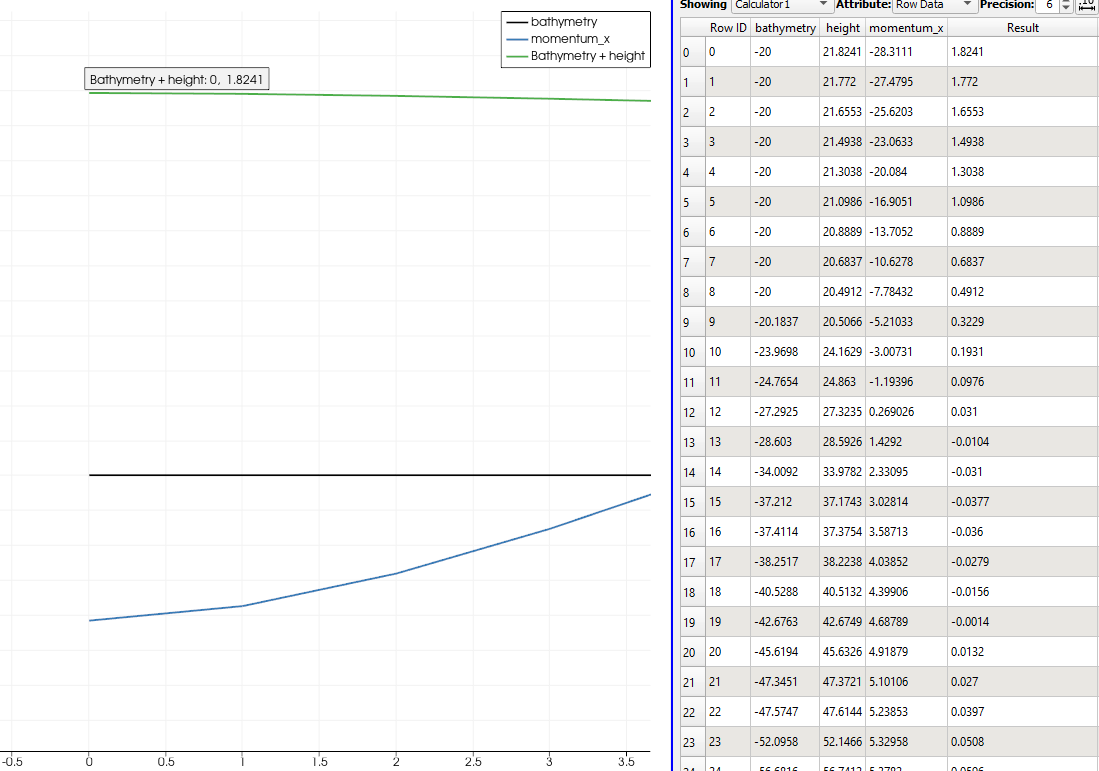
the runup is approximately 1.8241 meters.
4.6. Personal Contribution
Ward Tammaa, Daniel Schicker Doxygen Documentation
Mohamad Khaled Minawe, Ward Tammaa, Daniel Schicker Sphnix Documentation
Daniel Schicker, Mohamad Khaled Minawe , Ward Tammaa functions implementation
Mohamad Khaled Minawe, Daniel Schicker, Ward Tammaa Unit Testing
Mohamad Khaled Minawe, Daniel Schicker Geogebra Datei(Calculations for the Unit Tests)
Ward Tammaa Hosting the code , Action runner